

Introduction
If you have ever picked up rice from your pantry and found black specks flitting about, you know why you need a sealed rice storage container. A sealed grain storage container prevents pests, preserves freshness, and saves money by preventing food waste, making it the most beneficial upgrade you can make to your kitchen pantry. No chemical sprays, no complex routines. Just a well-designed sealed rice storage container that does the work for you.
The Science Behind Sealed Storage—Why Your Rice Bag Isn’t Enough
Most people keep rice in the original bag it comes in, usually folded and closed with a clip or rubber band. However, that packaging is not designed for long-term storage. Once opened, it gradually allows air, moisture, and pantry pests to enter, which can affect rice quality over time. Switching to a sealed rice storage container fundamentally improves this condition by creating a more stable and protected storage environment.
How Oxygen Becomes the Enemy (and How Sealing Becomes the Solution)
Inside a properly sealed environment, a natural process occurs over time. When rice is stored in an airtight sealed rice storage container, any insects or eggs already present are confined within a limited oxygen space. As they respire, oxygen levels slowly decrease, eventually reaching a point where insect activity is reduced, and reproduction can no longer continue.
Because of this natural mechanism, chemical treatments or additional pest control methods are not necessary. In practical terms, the sealed rice storage container itself functions as the main protection system.
While exact conditions may vary, studies on hermetic storage systems have consistently shown a clear reduction in insect activity and grain contamination compared with traditional storage methods. This makes airtight storage a practical and low-intervention solution for everyday household use.
Beyond Bugs: Moisture Protection That Preserves Texture
Rice is highly sensitive to surrounding humidity and can easily absorb moisture from the air. In humid environments, this often results in clumping, texture changes, and a noticeable drop in freshness. A properly designed sealed storage system helps reduce exposure to external moisture and maintains a more stable condition for stored grains over time.
This is particularly important in regions with high humidity, where improper storage can quickly degrade food quality. With a sealed rice storage container, the goal is to maintain a consistent internal environment so that the rice remains dry and usable for longer.
The Numbers Behind Storage Losses in Everyday Use
Across various storage studies, a consistent trend has emerged: traditional containers are more likely to experience grain loss over time due to exposure to air, moisture, and pests, whereas airtight storage systems significantly reduce these risks.
In everyday household use, even small differences in spoilage or weight loss can accumulate over time, especially for families that purchase rice in larger quantities. That is why more households are turning to airtight solutions like a sealed rice storage container—not only for convenience, but also for improved long-term storage efficiency.
What Actually Makes a Container “Sealed”—And Why Not All Are Created Equal
Walking through a kitchen supply store or browsing online, you’ll see many products labeled “airtight.” But there’s a wide gap between marketing claims and genuine hermetic protection. Here’s what you need to check before buying any sealed rice storage container.
The Seal Itself: Silicone Gaskets vs. Flimsy Lids
A truly sealed rice storage container relies on a flexible gasket that compresses against the rim when closed. Food-grade silicone is the gold standard here—it remains pliable through temperature changes, resists cracking, and doesn’t absorb odors.
Look for containers with either:
-
A physical locking mechanism (clips or latches that hold the lid down with tension)
-
A screw-top design with a built-in silicone ring
-
A press-seal lid with an audible click confirming closure
What to avoid: Containers where the lid just sits on top without a visible seal. Those may keep dust out, but they won’t maintain the low-oxygen environment needed for pest control. That’s not a real sealed rice storage container.
The Role of Material: Food-Grade Plastic, Glass, or Metal?
Your material choice affects safety, durability, and visibility. A premium sealed rice storage container should use BPA-free food-grade materials.
| Material | Pros | Cons | Best For |
|---|---|---|---|
| Food-grade PET plastic | Lightweight, shatterproof, transparent for easy visibility, and BPA-free options are widely available. | Can scratch over time, may absorb odors if low-quality | Daily use, households with children, seeing contents at a glance |
| Glass | Non-porous, no odor absorption, elegant appearance, oven-safe (varies) | Heavy, breakable, and often with a smaller capacity | Countertop display, smaller kitchens, and eco-conscious users |
| Stainless steel | Virtually indestructible, rust-proof, blocks light (reduces oxidation) | Opaque (can’t see inside), expensive, heavy | Long-term bulk storage, outdoor or garage use |
For most households, a BPA-free food-grade PET sealed rice storage container offers the best balance of practicality and performance. It’s lightweight, transparent, so you can monitor your rice supply, and resistant to moisture absorption.
Design Details That Make or Break Daily Use
Beyond the seal itself, consider:
-
Wide mouth opening – Makes scooping easy and cleaning even easier. Narrow openings trap grains in corners and become breeding grounds for bacteria.
-
Smooth interior – Rough seams or textured surfaces catch rice dust and moisture, creating conditions for mold. Run your finger along the inside—if you feel ridges, keep looking for another sealed rice storage container.
-
Transparent body – Being able to see how much rice remains without opening the lid is a small feature that pays off daily. Each time you open a sealed rice storage container, oxygen re-enters and resets the clock on pest protection. Transparent walls reduce unnecessary openings.
A well-designed sealed rice storage container should require less than a second to open, pour from, and re-seal—no struggling with complicated latches or misaligned lids.
The Funnel Advantage—Why the Right Shape Transforms How You Use Your Grain Container
Most sealed containers look like simple boxes or cylinders. But one design stands apart for its practicality: the funnel-shaped opening. When you combine a funnel design with a sealed rice storage container, you get effortless dispensing and natural grain rotation.
From Scoop to Pour: Less Mess, Less Waste
Traditional wide-mouth containers require a scoop or cup to extract rice. That scoop touches the grain, potentially introducing moisture or contaminants. It also inevitably leads to spillage—grains bouncing off the scoop, scattered across your countertop, swept into the trash. Over a year of daily cooking, those scattered grains add up to measurable waste.
A funnel-shaped discharge system changes the game entirely. Instead of opening the entire lid to scoop, you pour directly from a narrower opening at the bottom or side. The funnel geometry guides grains out smoothly, in controlled amounts, with virtually no spillage. This design has been used in commercial grain handling for years—industrial hopper-bottom containers utilize funnel interiors to empty thousands of pounds in seconds. Translating that principle to a household sealed rice storage container makes daily rice retrieval effortless.
FIFO Principle: First In, First Out
Anyone who has stored rice in a deep container knows the problem: older rice settles at the bottom, while fresh rice gets poured on top. Over time, you end up with rice that’s been sitting for months—maybe stale, maybe infested—buried beneath newer batches.
A funnel-shaped sealed rice storage container with a bottom or side dispensing port naturally follows the FIFO (First In, First Out) principle. The oldest rice, having settled at the bottom by gravity, exits first when you pour. Newer rice sits on top and only reaches the dispensing port after the older supply is depleted. No digging, no forgotten grains, no waste from expired rice hidden at the container’s bottom. This is a feature you won’t find in a basic jar.
Space Efficiency and Kitchen Aesthetics
In smaller kitchens where every square inch matters, shape affects storage. Funnel-style sealed rice storage container designs are often vertical and stackable. They tuck neatly into pantry corners or fit beneath upper cabinets without wasting the dead space that rounded containers leave behind.
By the Numbers—How a Sealed Container Saves You Money
Investing in a quality sealed rice storage container costs upfront but pays dividends over time. Let’s run the math for an average household that cooks rice 3–4 times per week.
Preventing Spoilage and Infestation Losses
The average household throws away approximately 13.9% of food from post-harvest to retail stages globally, with post-harvest handling accounting for 41.6% of emissions. Household-level storage losses are a real contributor to that waste. Consider this: if 2 billion people left just one teaspoon of rice uneaten daily, annual rice waste would reach approximately 730,000 tons. Food waste reduction starts at home, and a properly sealed rice storage container is the first line of defense.
A 10kg bag of premium jasmine rice costs around 25–35, depending on your region. Improper storage leads to 154–5 per bag thrown away. Over a year of purchasing 6–8 bags, you’re losing $25–40 annually. The cost of a quality sealed rice storage container? Often recouped within 6–12 months.
Extended Shelf Life Means Bulk Buying Benefits
A 2025 review found that vacuum-sealed and airtight containers preserve food “fresh for weeks” longer than traditional storage methods, enabling bulk purchasing without spoilage concerns. Bulk buying typically saves 15–30% per pound compared to smaller packages. With a reliable sealed rice storage container, you can confidently purchase 20-pound or 50-pound bags, decant them immediately upon arrival, and store them for months without quality degradation.
Reducing Kitchen Stress (Which Has Its Own Value)
Beyond the dollars, there’s a quality-of-life factor. No more opening your pantry and finding weevils crawling through your rice. No more running to the store mid-meal prep because your stored rice is stale. No more cleaning up spilled grains from the counter every time you scoop. That peace of mind has real value—and it comes free with the right sealed rice storage container.
Comparison—Sealed vs. Every Other Storage Method
Not all storage methods are equal. Here’s how a dedicated sealed rice storage container stacks up against common alternatives.
| Storage Method | Pest Protection | Moisture Control | Ease of Use | Estimated Shelf Life (Rice) |
|---|---|---|---|---|
| Original plastic bag + clip | Poor | Poor | Easy | 1–2 months |
| Glass jar with lid (non-sealed) | Moderate | Moderate | Moderate | 2–4 months |
| Plastic bin with snap lid (loose fit) | Moderate | Low | Easy | 2–3 months |
| Ceramic jar (porous) | Low | Low | Difficult | 2–3 months |
| Sealed rice storage container (silicone gasket) | Excellent | Excellent | Easy | 12+ months |
| Vacuum-sealed system | Excellent | Excellent | More complex | 12–18 months |
A 2025 comparison between ceramic jars and modern airtight containers showed that while ceramic offers aesthetic appeal and eco-friendliness, it lacks true pest protection and space efficiency. Modern sealed rice storage container designs scored higher across every functional metric: freshness retention, pest protection, space efficiency, and ease of cleaning.
The Stacking Test
Another practical consideration: Does your storage solution allow you to use vertical space efficiently? Stackable sealed rice storage container models can increase storage capacity by 50% compared to non-stackable alternatives. In kitchens where cabinet space is at a premium, that’s a decisive advantage.
Real-World User Scenarios—Who Needs a Sealed Rice Storage Container?
This isn’t a niche product. Different households benefit for different reasons. If any of these sound like you, a sealed rice storage container is a must-have.
Scenario 1: The Humidity-Addicted Kitchen (Tropical Climates)
Living in Singapore, Florida, or any region where humidity regularly exceeds 70%? You’ve probably noticed that rice left in its original bag absorbs ambient moisture within days. That moisture promotes mold growth, clumping, and a stale texture that no amount of rinsing can fix. A sealed rice storage container with a silicone gasket blocks that humidity entirely. One Singapore-based reviewer noted using a clamped glass jar with a rubber seal “during typhoon season—still dry inside!”
Scenario 2: The Weevil Survivor (Everyone Else)
Weevils and rice moths don’t care how clean your kitchen is. They arrive in grain products from the store, either as adults or as eggs invisible to the naked eye. Once opened, those eggs hatch,h and the infestation spreads. A sealed rice storage container kills existing insects via oxygen deprivation and prevents new ones from entering. “Since I got this, I never see weevils again,” reported one longtime user of an airtight container system.
Scenario 3: The Bulk Buyer and Meal Prepper
If you buy rice in 20-pound or 50-pound bags to save money, you need a storage solution that preserves quality across months. Decanting into multiple sealed rice storage containers immediately upon purchase locks in freshness and lets you rotate stock efficiently. The FIFO funnel design ensures you’re always using the oldest rice first.
Scenario 4: The Multi-Grain Household
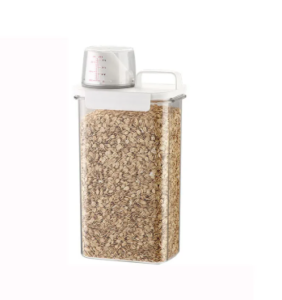
Does your kitchen contain not just rice, but quinoa, lentils, oats, farro, and various flours? A transparent sealed rice storage container lets you see at a glance which grain is which and how much remains. Label each container with contents and date of purchase for even better organization. Some containers offer lid-integrated measuring spoons that eliminate the need for separate tools, cutting prep time by an estimated 20%.
FAQ
Q1: Can I store other dry goods in a sealed rice storage container?
Yes. A sealed rice storage container is suitable for a wide range of dry foods, including flour, oats, quinoa, lentils, beans, pasta, cereal, nuts, coffee beans, and even pet food. However, it is recommended not to mix different grains in the same container to maintain better hygiene and organization.
Q2: How often should I clean my sealed rice storage container before refilling?
It is best to clean the container each time you finish a batch of rice or other grains. Wash it with warm soapy water, rinse thoroughly, and allow it to dry completely before refilling. Any remaining dust or broken grains may trap moisture and increase the risk of mold forming in the next use.
Q3: Will a sealed rice storage container protect rice that already has weevils?
Yes. Once properly sealed, the oxygen level inside will gradually decrease, which leads to insect inactivity and eventual suffocation within 10–21 days. However, for the best results and food safety, it is still recommended to discard heavily infested rice and start with fresh grain.
Q4: Is plastic safe for long-term use in a sealed rice storage container?
Yes, as long as food-grade materials are used. BPA-free PET and PP plastics are widely considered safe, durable, and compliant with food contact standards. Always ensure your sealed rice storage container is clearly labeled as food-grade before long-term use.
Q5: How can I tell if my container is truly sealed?
You can perform a simple water test by filling the container partially, sealing the lid, and turning it upside down. If no leakage occurs, it indicates a proper seal. In daily use, an audible click or noticeable resistance when closing the lid also suggests a secure, sealed rice storage container.
Stop Throwing Away Rice—Start Sealing It
A sealed rice storage container eliminates insect infestations without chemicals, preserves moisture balance, extends shelf life from weeks to months, and saves you money on spoiled grain. Whether you live in a humid climate, cook rice daily, buy in bulk to save money, or simply want a cleaner, more organized pantry—this is the upgrade that delivers.
Don’t wait until you find weevils in your rice again. The cost of one bag of spoiled grain already exceeds the price of a quality sealed rice storage container. Make the switch today. Your rice (and your wallet) will thank you.
Ready to protect your grains the smart way? Browse our selection of food-grade sealed rice storage containers with funnel-shaped dispensing systems—engineered for freshness, designed for daily convenience.