


소개
If your bedroom is always messy, no matter how often you clean it, the problem may not be your closet; it may be the wasted space under your bed. A simple 침대 밑 수납함 can keep extra clothes, bedding, shoes, and other everyday items organized without taking up any floor space. A design that incorporates a box will also help make your room feel cleaner, more organized, and more comfortable to live in.
Why Your Bedroom’s Biggest Storage Problem Has a Simple Solution
Walk into almost any small bedroom, and you’ll spot the same struggle: bulging closets, overflowing dressers, and floor space cluttered with shoes, bags, and random items that have nowhere else to go. The average bedroom size in U.S. cities has been shrinking for years, yet our volume of belongings keeps growing. In fact, 40% of people living in small spaces say they have unused space in their homes—primarily in their bedrooms. Meanwhile, research from the Furniture Industry Research Association found that properly utilizing under-bed space can add approximately 150 liters of additional storage capacity. That‘s roughly the equivalent of adding two full dresser drawers, yet most people leave this area empty or use it incorrectly.
This disconnect matters because clutter isn’t just an eyesore—it creates measurable stress. Research has shown that decluttering can reduce stress by up to 77%, transforming a chaotic bedroom into a peaceful retreat. And in small bedrooms, every square inch counts. For a queen-size bed, the space underneath offers between 15 and 25 cubic feet of potential storage.
The global home organizers and storage market was valued at USD 12.8 billion in 2024 and is expected to reach USD 18.72 billion by 2031, growing at 5.60% annually. Under-bed storage specifically has seen explosive growth, with Amazon US monthly search volume for “under-bed storage” exceeding 500,000 and rising 37% year over year.
Clearly, you’re not alone in recognizing the power of an underbed storage box. But not all storage solutions are created equal, and buying the wrong type can actually make your clutter problem worse.
What Makes a High-Quality Underbed Storage Box Actually Work
Let‘s get specific. After analyzing dozens of products and combing through thousands of customer reviews, certain features consistently separate winners from regrets. Here’s what the data tells you to look for.
Clear Visibility Saves You from “Out of Sight, Out of Mind”
One of the biggest mistakes people make with under-bed storage is using opaque boxes. Out of sight quickly becomes out of mind, and before you know it, you own five boxes of mystery items that never see the light of day. Clear underbed storage boxes solve this immediately. You can see exactly what‘s inside without dragging out heavy containers and digging around. This simple feature eliminates the #1 reason under-bed storage fails: forgotten items.
Professional organizers consistently recommend transparent containers for exactly this reason. When you can visually scan your stored items at a glance, you’re far more likely to actually use what you‘ve stored.
Wheels Turn Frustration into Effortless Access
Here’s a number worth remembering: 32% of negative reviews for traditional storage boxes cite “difficult to pull out” as the primary complaint. That‘s nearly one in three customers whose storage solution makes their life harder instead of easier.
The fix is simple but transformative: an underbed storage box with wheels. Quality rolling drawers glide out smoothly, even when fully loaded with heavy winter blankets, eliminating the need to crawl on the floor or strain your back. On modern products, wheels are often made from durable PU material designed to withstand tens of thousands of pulls without seizing up. Look for hidden or recessed wheel designs that don’t snag on carpet fibers or scratch hardwood floors.
Breathability vs. Sealing – Know What You‘re Storing
Not everything should be sealed airtight. Breathable storage bags with structured sides are essential for natural fibers like wool and silk, which need airflow to prevent degradation and mustiness. If you’re storing linens, extra bedding, or delicate fabrics, breathable underbed storage box options with fabric panels allow air circulation while still protecting against dust.
For seasonal clothing, holiday decorations, or items you won‘t touch for months, sealed plastic containers provide superior dust and moisture protection. The best approach isn’t choosing one over the other—it‘s having both types available for different categories of items.
Weight Capacity and Durability Matter More Than You Think
The market research reveals a sobering reality: nearly 44% of negative reviews for under-bed storage products point to “weak material”—plastic cracking, fabric tearing, or bottoms collapsing under moderate weight. Another 14.6% cite “structural instability,” where boxes deform when loaded with heavy items.
A quality underbed storage box needs to handle real weight. Look for PP (polypropylene) or HDPE (high-density polyethylene) construction—both offer excellent strength-to-weight ratios and resist cracking. If you’re choosing fabric options, reinforced frames (such as carbon steel support structures) can handle up to 50 kg when properly designed.
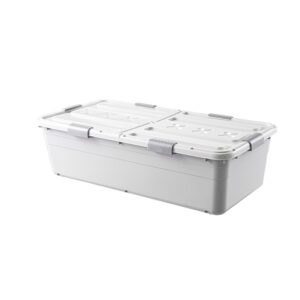
Material Deep Dive: Why Plastic Underbed Storage Boxes Dominate the Market
When comparing underbed storage box materials, plastic consistently outperforms alternatives across nearly every practical metric. Let‘s break down why.
Plastic vs. Cardboard: A One-Sided Battle
Cardboard boxes might seem like a cheap solution—and they are, initially. But cardboard has significant drawbacks that make it unsuitable for long-term under-bed storage. Cardboard offers no water resistance whatsoever, absorbs ambient moisture, and collapses under heavy stacking. In contrast, plastic underbed storage boxes provide durable, water-resistant, strong, and reusable protection. Plastic containers maintain their shape year after year, stack securely, and survive the inevitable bumps and slides when you pull them out from under the bed.
Plastic vs. Fabric: Each Has Its Place
Fabric storage bags dominate the low-price tier, typically ranging from $20–25, and they’re popular for a reason—they‘re lightweight, flexible, and often fold flat when not in use. However, fabric boxes have shorter lifespans, are prone to tearing at seams, and offer limited structural integrity. Fabric storage represents nearly 80% of the under-bed market by unit volume, but plastic and rigid options are the fastest-growing segment, with sales increasing over 200% in recent years.
Plastic underbed storage boxes win for durability, stackability, and protection against both dust and moisture. They’re ideal for heavier items, long-term storage, and anyone who wants a solution that lasts.
Understanding Plastic Grades: PP, PE, and What to Look For
Not all plastic is equal. Here‘s a quick guide to the materials you’ll encounter:
-
폴리프로필렌(PP): Lightweight, strong, moisture-resistant, and moderately durable with some flexibility. Ideal for general-purpose underbed storage boxes.
-
HDPE (High-Density Polyethylene): Superior impact resistance due to its denser structure. Perfect for storage boxes that need to withstand rougher handling and heavier loads.
-
LDPE (Low-Density Polyethylene): More flexible and cost-effective, but less durable for heavy-duty applications.
For most home users, PP offers the best balance of durability, weight, and cost-effectiveness. If you’re storing particularly heavy items or expect frequent movement, step up to HDPE.
How to Choose the Right Underbed Storage Box for Your Specific Needs
Not every bedroom has the same clearance, and not every user stores the same items. Here‘s how to match the product to your situation.
Measure First, Buy Second – It’s That Simple
The most common mistake people make is buying storage without measuring their bed‘s clearance. Standard bed frames typically offer 6 to 8 inches of space underneath—barely enough for low-profile bins. Platform beds often have less, while older bed frames with box springs may have significantly more.
Before you shop for an underbed storage box, measure the distance from the floor to the bottom of your bed frame at all four corners. Then subtract at least half an inch to ensure smooth sliding. Nothing is more frustrating than buying boxes that don’t actually fit.
Capacity by Bed Size: What to Expect
| Bed Size | Approximate Under-Bed Area | What Fits |
|---|---|---|
| Twin/Single | ~35 sq ft | 2–3 medium boxes or 1 large rolling drawer |
| Full/Double | ~45 sq ft | 3–4 medium boxes or 2 large containers |
| Queen | ~55 sq ft | 4–5 boxes or 2–3 rolling drawers |
| King | ~70 sq ft | 6+ boxes or full coverage with multiple units |
For context, 150 liters of under-bed storage—the average additional capacity you can unlock—is roughly equivalent to three large moving boxes or two full suitcases of clothing.
Rolling Drawers vs. Lidded Boxes: Which Fits Your Life?
-
Rolling drawers: These function like built-in dresser drawers, sliding out on wheels without lids. Perfect for items you access weekly—extra pillows, workout clothes, or craft supplies. The drawback is less dust protection than lidded options.
-
Lidded boxes with wheels: The best of both worlds. You get the mobility of wheels plus full dust and moisture protection. Ideal for seasonal rotation and long-term storage.
-
Basic lidded bins: Most affordable, but without wheels, accessing them is a hassle. Only recommend items you rarely need.
Consumer data from 2025 shows that among top-selling under-bed storage products, wheeled and foldable designs account for 62% of the market, with prices concentrated in the $25–40 range.
Real-Life Scenarios: How an Underbed Storage Box Transforms Different Bedrooms
Numbers are helpful, but real-world examples make the value clear. Here are three common situations where the right underbed storage box changes everything.
Scenario 1: The College Student Dorm Room
College dorm rooms are famously tiny—often under 150 square feet for two occupants. A typical Twin XL bed sits about 30 inches off the ground, offering nearly 53 cubic feet of hidden storage space. That‘s room for an entire winter wardrobe swap, extra bedding, textbooks, and sports equipment. Students who use underbed storage boxes can keep their living space tidy enough to actually study in, while their roommates without storage live in chaos.
Data shows that 31% of under-bed storage users are college students, making this the single largest demographic segment.
Scenario 2: The Urban Apartment Dweller
City apartments average 20–30% smaller than suburban homes, yet urbanites often own just as many belongings. One underbed storage box can eliminate the need for a bulky dresser. Use one container for off-season clothes, another for linens, and a rolling drawer for daily-access items like pajamas or gym clothes. Suddenly, a cramped studio feels like a real home.
Scenario 3: The Family Home with Overflowing Closets
Parents know the struggle: kids outgrow clothes every season, sports gear accumulates, and holiday decorations need a home somewhere. The master bedroom’s under-bed space often becomes the family‘s overflow zone. By using multiple underbed storage boxes with clear labeling for “winter coats,” “summer clothes,” and “extra bedding,” families can rotate seasonal items without cluttering closets or losing things in the attic.
Comparison: Underbed Storage Box vs. Storage Alternatives
Not all storage solutions work equally well for small bedrooms. Here’s how an underbed storage box stacks up against common alternatives.
| Storage Solution | 공간 효율성 | Accessibility | Dust Protection | Typical Cost |
|---|---|---|---|---|
| Underbed storage box (wheels + lid) | 우수 | Very Good | 우수 | $25–40 |
| Regular plastic bin | Poor (takes floor space) | 보통 | Good | $15–25 |
| Vacuum storage bag | Good for soft goods; poor for hard items | Poor | Good | $10–20 |
| Bed frame with built-in drawers | 우수 | Very Good | Very Good | $300+ |
| Cardboard box | Fair | Poor | None | $5–10 |
Key takeaway: An underbed storage box beats regular bins because it doesn’t consume visible floor space and keeps clutter out of sight. Compared to vacuum bags, storage boxes win for hard goods like shoes and books, while vacuum bags are better for compressing bulky bedding or clothing. For the best of both worlds, combine them—vacuum-seal soft items, then place them inside your underbed storage box.
Bed frames with built-in drawers offer a cleaner, more permanent solution, but cost significantly more upfront and don‘t offer the flexibility to rearrange or move your storage when you change bedrooms.
Expert Tips for Making Your Underbed Storage Box Work Harder
Professional organizers have refined under-bed storage into a science. Here are their most actionable recommendations.
Start with a total clean-out. Pull everything from under your bed and sort into three piles: keep, donate, or trash. If you haven‘t used something in a year, you probably never will. Take this opportunity to vacuum thoroughly—dust and allergens accumulate quickly in neglected under-bed spaces.
Create zones, not piles. Assign specific areas under your bed to different categories. Keep seasonal clothes on one side, extra bedding in the middle, and rarely used items toward the back. Label everything—a simple piece of tape with “winter sweaters” saves you from searching through multiple boxes later.
Use vacuum-sealed bags inside your underbed storage box. This hybrid approach gives you the compression benefits of vacuum bags with the structural integrity and dust protection of a hard-sided box. You can reduce the volume of soft goods by 75–80% while keeping them organized and accessible.
Position items strategically. Don’t bury your go-to items behind other storage. Put daily essentials in rolling drawers at the front edge of the bed, and relegate truly seasonal items to the back or to lidded boxes.
Rotate seasonally. Use your underbed storage box for the off-season wardrobe. When spring arrives, pack away winter coats and pull out summer clothes. This system keeps your closet lean year-round and ensures you actually use what you‘ve stored.
FAQ
Q: Will an underbed storage box fit under any bed frame?
Not automatically. Standard bed clearance is 6–8 inches, but low-profile platform beds may have only 4–5 inches. Always measure before buying.
Q: Can I store heavy items like books in an underbed storage box?
Yes, but choose rigid plastic or reinforced fabric boxes with adequate weight capacity. Avoid basic fabric bins for heavy items—their bottoms can sag or tear.
Q: How do I keep dust from getting into my underbed storage box?
Use lidded boxes with secure seals. Boxes with wheels and lids provide the best dust protection. Avoid open baskets or soft bags, which collapse and collect dust.
Q: Are clear boxes really better than colored or opaque ones?
Yes. Clear containers let you see contents instantly, eliminating the “out of sight, out of mind” problem that causes forgotten items and duplicate purchases.
Q: Can I stack multiple underbed storage boxes?
Only if your bed has sufficient vertical clearance, measure first. If space allows, stack the heaviest boxes on the bottom and put rarely used items in the top boxes.
Ready to Transform Your Bedroom?
Choosing the right underbed storage box can make a noticeable difference in how a small bedroom feels and functions. Whether you need extra space for seasonal clothing, bedding, shoes, or everyday household items, a low-profile storage solution helps keep everything organized and easy to access.
Clear designs, smooth-rolling wheels, and durable plastic are features worth paying attention to before buying. A storage box that fits your bed properly will be much easier to use in daily life.
Explore different underbed storage options and choose the design that best fits your space and storage habits.