
Introduction
You pack the tent, sleeping bags, cooler, camp stove, chairs, and a few “just-in-case” bags. By the time everything is in the trunk, it looks more like chaos than preparation.
Need the first-aid kit? You end up unpacking half the load just to reach one small item, then spend even longer putting everything back.
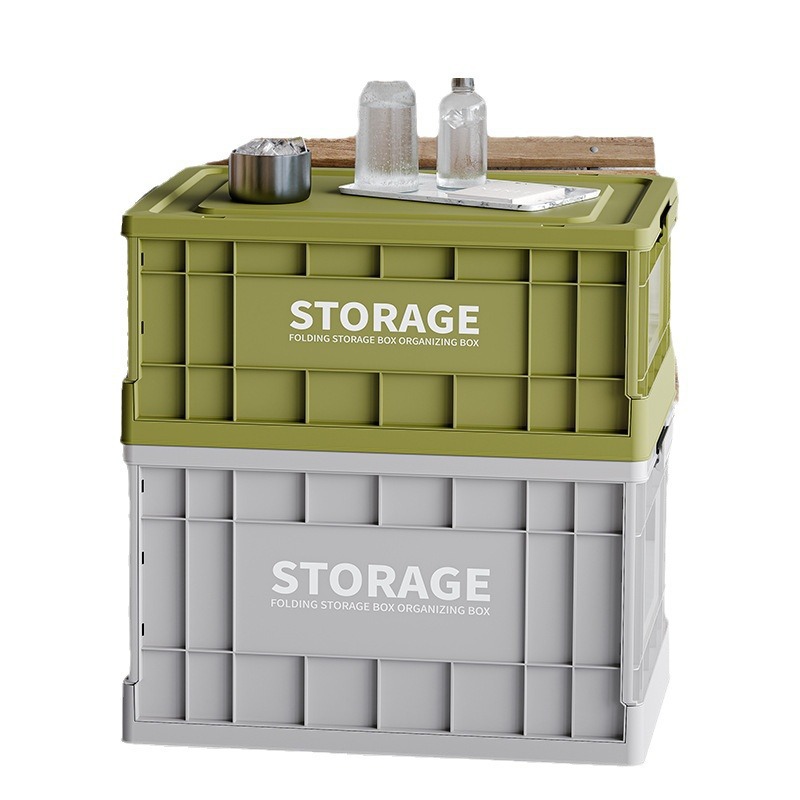
A folding storage box for camping changes that dynamic. It turns loose, shifting gear into a structured system where everything has a place and can be accessed quickly without digging through piles.
But here is the reality: not all folding storage boxes perform well. Some collapse under weight, some waste space even when folded, and others look useful but fail in real road-trip conditions.
This guide breaks down what actually works. You will learn when a folding storage box for camping is worth using, which features separate durable models from poor designs, and how to choose a camping storage box that can handle real travel conditions without failing mid-trip.
Core Decision — Why a Folding Storage Box for Camping Works
A folding storage box for camping solves one fundamental problem: loose gear shifts, tips, and buries itself. The box creates fixed compartments so items stay where you put them. But three failure points separate useful boxes from frustrating ones.
Failure Point 1: Side Access That Doesn’t Work in a Trunk
Top-load only bins are useless when stacked under other luggage. The most practical folding storage box for camping SUV storage has side-opening panels. Open the trunk, flip down the side door, and grab the item without moving anything above. Many cheap folding boxes claim side access but place the opening too high or too small. A genuine side-opening folding storage box for camping lets you reach the bottom corner of the box while the box sits fully loaded in the trunk. Without this, you might as well use a cardboard box.
The best side panels measure at least 25 cm wide and 15 cm tall. They should stay open on their own — magnets or hook‑and‑loop straps hold the door open while you dig. Some premium models have a transparent window in the side panel, so you can see what is inside without opening it at all. This matters when you have three identical black boxes stacked in the dark trunk at night.
Failure Point 2: Walls That Collapse Under Weight
Fabric boxes with thin walls bulge outward when loaded with heavy items like canned goods or water bottles. Bulging walls mean the box loses shape, items jam together, and the lid won’t close. A durable folding storage box for camping trunk has internal stiffeners — rigid panels sewn into the fabric — or uses polypropylene plastic that stays rigid. When you see a folding storage box for camping, a large capacity rated for 50L or more, check whether the walls stay straight at full load. If the product photos show a box with straight walls, but customer photos show bulging, avoid it.
Materials matter: 1680D Oxford polyester with foam padding inside the walls resists bulging better than 600D without padding. Polypropylene boxes with interlocking panels are the most rigid but fold less flat. Some hybrid designs use a rigid plastic base and fabric upper walls — a practical compromise. The base stays flat, the top does not sag.
Failure Point 3: Locking Mechanism That Pops Open
Driving down a bumpy forest road, your loaded folding box suddenly collapses because a clip failed. Good box locks — plastic latches or metal clips — hold the lid and side panels securely. The box should remain rigid even when you lift it full by the handles. Test: after closing, shake the box. If anything rattles or feels loose, it will open mid-trip. A reliable folding storage box for a camping car organizer must stay closed under vibration.
Metal clips last longer than plastic. Look for clips with a secondary locking position — two audible clicks when closing. Some boxes use a zipper to close the top, but zippers fail when overloaded or dusty. Avoid zipper‑only closures for heavy gear.
When a Folding Storage Box for Camping Saves Your Trip
A folding storage box for camping is not a universal solution. It shines in three specific scenarios.
Scenario 1: Family Camping with Mixed Gear
You have sleeping bags, a stove, food, tools, and kids’ toys. Without a box, you rummage for the marshmallow roasting sticks while the cooler leaks on everything. A folding storage box for camping large capacity (60–70L), organizes categories. One box for cooking gear, one for dry food, one for clothes. Side access lets you grab the propane canister without unstacking the tent bag. This is where a folding storage box for camping road trip use proves its worth — quick access, not just storage.
Families benefit from color‑coded boxes. Red for kitchen, blue for clothes, green for tools. When you arrive at camp, each person grabs their assigned box. Kids can carry a box to their tent. The boxes stack in the corner of a campsite, keeping gear off the damp ground.
Scenario 2: Overlanding or Extended SUV Storage
You live out of your vehicle for days. Gear needs to be accessible multiple times per day. A folding storage box for camping SUV storage with multiple compartments (pockets inside, dividers) lets you store a tool kit, emergency supplies, and snacks. The box becomes a mobile drawer system. When you camp, lift the box out and set it on the ground — your entire camp kitchen moves as one unit.
Overlanders often use two boxes side by side in the cargo area. One for food and cooking, one for clothing and sleeping gear. The boxes slide out on a plywood shelf or sit on a cargo tray. Some foldable boxes have molle webbing on the front for attaching small pouches — perfect for headlamps, lighters, and multi‑tools.
Scenario 3: Apartment Dwellers with Limited Space
You camp three weekends per year. Between trips, a rigid bin consumes floor space in your small apartment. A folding storage box for camping collapses to a 4–6 cm thickness. It slides under the bed or behind a shelf. No compromise on capacity when expanded, no permanent space wasted. For these users, a folding box is not just convenient — it is the only practical option.
Some models collapse into a flat panel the size of a laptop bag. You can store two or three collapsed boxes in the same space as a single shoebox. When friends invite you on a last‑minute trip, you grab the flat box from the closet, pop it open in ten seconds, and pack.
How to Choose a Folding Storage Box for Camping
Stop looking at brand names. Judge on four criteria.
Criterion 1: Side Opening Usability
Open the side panel while the box is on the floor. Can you reach the far corner? Does the panel stay open on its own, or do you need a second hand? The best folding storage box for camping car organizer has side doors that flip down and stay down via magnets or elastic straps. The opening should be large enough for an adult’s hand to reach in and pull out a water bottle or a folded rain jacket. Avoid boxes with tiny side “windows” that only fit a phone.
Reach test: Put a water bottle in the back corner of the box, close the lid, and try to retrieve the bottle through the side opening. If you cannot reach it without opening the top, the side opening is poorly placed. Good designs place the side panel low, near the bottom of the box, so you can access items that settle to the bottom.
Criterion 2: Collapsed Height
A folding storage box that folds to 8 cm thick is worse than one that folds to 4 cm. Measure the collapsed profile. The whole point of folding is to store flat. If the collapsed box is still bulky, you lose the space advantage. Many folding storage boxes for camping, large capacity models compromise on foldability — they use thick plastic panels that do not collapse completely. True folding boxes use fabric hinges or interlocking PP panels that stack nearly flat.
The best collapsed height is under 5 cm. At that thickness, you can slide the box between a sofa and a wall. You can tuck it behind a bookshelf. You can store it in the footwell of the back seat. Some ultra‑compact models fold to 3 cm but sacrifice side opening — choose based on your priority.
Criterion 3: Load-Bearing Lid
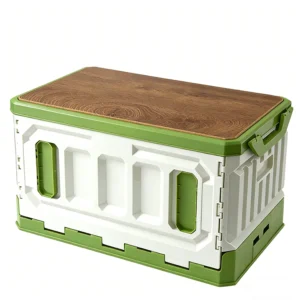
The wooden lid trend exists because it works. A folding storage box for camping with a solid lid becomes a camp table, cutting board surface, or seat. Check two things: lid weight capacity (can you sit on it?) and lid attachment (does it slide off, or clip on?). A detachable lid is fine, but an attached lid that hinges open is more convenient. Models with a lid that flips up and stays up allow one‑handed access.
Weight capacity matters if you plan to sit on the box. Look for boxes rated for 100 kg (220 lbs) or more. The lid should not flex under your weight. Some boxes have a bamboo or birch plywood lid that doubles as a chopping board — no need to pack a separate cutting board.
Criterion 4: Material Thickness and Construction
For fabric boxes, look for 600D polyester minimum, preferably 1680D with reinforced corners. For plastic boxes, 2–3mm PP walls are adequate. The material thickness directly affects how long the box survives. A durable folding storage box for camping trunk will have double‑stitched seams, heavy‑duty zippers (if any), and metal or reinforced plastic clips — not thin, breakable plastic tabs.
Check the seams: are they double‑stitched? Are stress points (handles, corners, clip attachments) reinforced with extra fabric or plastic webbing? Cheaper boxes use single stitching that unravels after a few trips. Look for boxed corners on the bottom — that indicates the fabric is folded before stitching, much stronger than simple cut edges.
Comparison: Folding Box vs. Rigid Bin vs. Duffel
| Scenario | Choose Folding Box | Choose Rigid Bin | Choose Duffel Bag |
|---|---|---|---|
| Occasional camping (monthly) | Yes – folds flat at home | No – takes permanent space | Maybe – but no structure |
| Live-in vehicle (weekly trips) | Yes – side access, organization | Yes – very durable, waterproof | No – too floppy |
| Apartment storage | Yes – collapses small | No | Yes – rolls small |
| Transport heavy/abrasive gear | No – fabric may tear | Yes – hard shell | No |
| Need daytime trunk access | Yes – side panels | No – top load only | No |
| Box as campsite furniture | Yes – wooden lid models | No | No |
For most car campers and road trippers, a folding storage box for camping offers the best balance of organization, space efficiency, and trunk accessibility. Only choose rigid bins if you need waterproofness or heavy drop protection. Only choose duffels if you will carry the bag on your back for a distance.
Real User Insights and Market Context
Folding storage boxes have grown popular because they solve a real problem: trunk chaos. The global camping storage containers market is projected to grow at 4.6% CAGR through 2035, driven by more people taking road trips and overlanding. User reviews consistently highlight three make‑or‑break details: side opening usability, wall rigidity, and collapsed thickness, not brand name or price.
One user packed a 70L folding box with a case of water (24 bottles), tools, and camping gear. The box sagged at the sides but held — the internal stiffeners prevented complete collapse. Another user praised a box with a wooden lid that doubled as a prep table, eliminating a separate camp table purchase. A third user reported that after two years of monthly use, the side clips broke — but the manufacturer sold replacement clips. That level of repairability is rare in cheap boxes.
Common complaints: side openings that are too small, clips that snap in cold weather, and fabric that absorbs the campfire smoke smell. Solutions: look for oversized side doors, nylon clips (more flexible in cold), and treated fabric that resists odors.
Maintenance and Care for a Durable Folding Storage Box for Camping Trunk
Even the toughest box lasts longer with basic care.
-
After each trip, shake out dirt and leaves. Use a soft brush for crevices.
-
Wipe fabric boxes with a damp cloth and mild soap. Do not submerge in water — the internal stiffeners may absorb moisture and develop mold.
-
For plastic boxes, rinse with a garden hose. Dry completely before folding.
-
Store boxes in a dry place. Do not stack heavy items on top of collapsed boxes — the hinges can deform.
-
Lubricate plastic clips and zippers with silicone spray once a year. Do not use oil‑based lubricants — they attract dirt.
-
If the fabric absorbs smoky smells, sprinkle baking soda inside, leave for 24 hours, then vacuum. Alternatively, wipe with a solution of equal parts water and white vinegar, then air dry in sunlight.
With proper care, a quality, durable folding storage box for camping trunk lasts five to ten years. Cheap boxes fail within a season — the math on cost per use favors a better upfront investment.
FAQ
Q1: Can a folding storage box for camping really hold heavy items without collapsing?
Yes, if walls have internal stiffeners or are made of rigid PP plastic. Avoid cheap fabric‑only boxes for heavy loads. Look for 1680D fabric with foam padding.
Q2: What is the most useful feature for a folding storage box for a camping car organizer?
Side‑opening panels. Without them, you cannot reach items buried under other trunk cargo. The side door must be low enough to access the bottom corner.
Q3: How does a folding storage box for camping SUV storage differ from a standard collapsible bin?
SUV storage boxes are sized to fit between wheel wells, have side access, and often include a load‑bearing lid for camp use. Standard bins are top‑load only.
Q4: What capacity should I look for in a folding storage box for camping, large capacity?
50–70 liters for weekend trips, 70–80 liters for week‑long trips. Measure your trunk height before buying — 80L boxes can be too tall for some SUVs.
Q5: How do I maintain a durable folding storage box for a camping trunk?
Shake out dirt, wipe with a damp cloth, dry fully before folding. Lubricate clips annually. Store collapsed in a dry place. Do not wash in a machine.
Q6: Can I use a folding storage box as a chair or stool?
Only if the box is rated for sitting weight, usually boxes with a wooden lid and reinforced walls. Check the manufacturer’s weight rating before sitting.
Q7: Are fabric folding boxes waterproof?
Most are water‑resistant but not waterproof. They handle light rain or a water bottle but will not protect contents if submerged. For wet conditions, use a plastic box or add a waterproof liner.
Q8: Why do some folding boxes have a wooden lid while others use plastic?
Wooden lids provide a work surface, look nicer, and can be used as a cutting board. Plastic lids are lighter, cheaper, and easier to clean. Choose based on how you camp — wood for glamping, plastic for rugged use.
Conclusion
A folding storage box for camping is genuinely useful — if you buy the right one. Prioritize side‑opening panels that work in a trunk, rigid walls that do not bulge, and a collapsed height that actually saves space. Avoid top‑load‑only bins and fabric boxes without stiffeners. For occasional campers, apartment dwellers, and anyone tired of trunk chaos, a quality folding storage box for camping road trip use transforms packing from frustration to efficiency.
The best folding storage box for camping car organizer does three things well: it stays closed on bumpy roads, opens from the side so you never unstack luggage, and collapses flat enough to hide between trips. It does not need a fancy brand. It needs solid clips, reinforced seams, and a design that matches how you actually pack.
Ready to stop digging through a pile of gear? Choose a durable folding storage box for camping trunk with side access, reinforced walls, and a folding design that fits your vehicle. Get organized, pack faster, and spend less time searching — more time camping.